
Differentiable Projection-Guided Graph Neural Networks for Large-Scale Logistics Optimization for Sustainable Renewable Energy
Keywords:
Large-Scale-Logistics, Graph Neural Networks, Optimization, Renewable energy, DPG-GNNAbstract
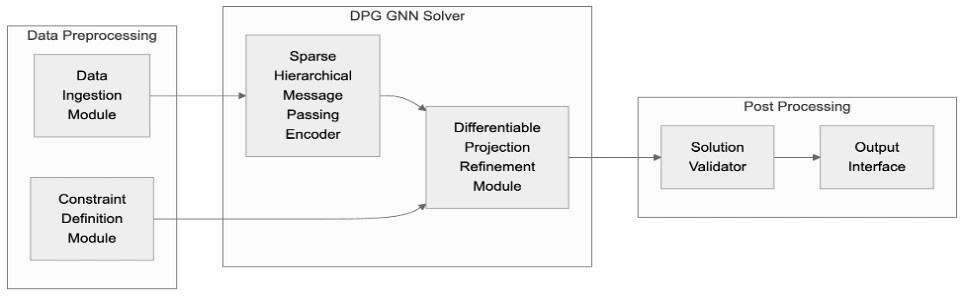
Maximum Combinatorial optimization problems in large-scale logistics networks, such as vehicle routing and node assignment, remain challenging due to their NP-hard nature and the stringent feasibility requirements imposed by real-world constraints. Conventional neural approaches often rely on autoregressive decoders or heuristic search, which scale poorly and struggle to guarantee constraint satisfaction. We propose a Differentiable Projection-Guided Graph Neural Network (DPG-GNN) that reformulates the solver as a parallel fixed-point iteration scheme integrating learnable differentiable projection operators. The architecture first employs a sparse hierarchical message-passing encoder to process raw logistics graph data, computing node embedding via a cluster-aware attention mechanism that maintains nearly linear complexity on large graphs. These embedding initialize a continuous relaxation of the decision variables. The core technical novelty is an iterative refinement module that alternates between a line-graph message-passing step and a parallelized alternating direction method of multipliers (ADMM) that projects the candidate solution onto the intersection of constraint polytopes, including simplex projections for capacity limits and Sink horn iterations for assignment constraints. The entire unrolled refinement process is trained end-to-end using a differentiable proxy loss that combines cost minimization with quadratic constraint penalties. At inference, a deterministic rounding and greedy repair procedure produces feasible integer solutions. The DPG-GNN avoids the sequential bottlenecks of autoregressive methods and learns to produce low-cost, nearly feasible continuous solutions directly. This work therefore introduces a principled framework for integrating constraint satisfaction directly into the differentiable optimization pipeline, with significant implications for large-scale logistics planning where both solution quality and computational efficiency are critical.
Downloads
References
[1] C. Papadimitriou and K. Steiglitz, “Combinatorial optimization: Algorithms and complexity,” books.google.com, 1998.
[2] A. Colorni, M. Dorigo, F. Maffioli, V. Maniezzo, et al., “Heuristics from nature for hard combinatorial optimization problems,” International Transactions in Operational Research, 1996.
[3] S. Liu, “Graph deep learning for data-driven combinatorial optimization,” pub.uni-bielefeld.de, 2026.
[4] Y. Jin, X. Yan, S. Liu, and X. Wang, “A unified framework for combinatorial optimization based on graph neural networks,” arXiv preprint arXiv:2406.13125, 2024.
[5] N. Vesselinova, R. Steinert, D. Perez-Ramirez, et al., “Learning combinatorial optimization on graphs: A survey with applications to networking,” IEEE Access, 2020.
[6] F. Wang, Q. He, and S. Li, “Solving combinatorial optimization problems with deep neural network: A survey,” Tsinghua Science and Technology, 2024.
[7] X. Huo and X. Wang, “Logistics network topology optimization and transportation scheduling using graph neural networks,” Engineering Research Express, 2026.
[8] G. Kochenberger, F. Glover, B. Alidaee, and C. Rego, “A unified modeling and solution framework for combinatorial optimization problems,” Or Spectrum, 2004.
[9] O. Vinyals, M. Fortunato, and N. Jaitly, “Pointer networks,” in Advances in neural information processing systems, 2015.
[10] Y. Xiao, D. Wang, B. Li, H. Chen, W. Pang, et al., “Reinforcement learning-based nonautoregressive solver for traveling salesman problems,” IEEE Transactions on Neural Networks and Learning Systems, 2024.
[11] Y. Jin et al., “Pointerformer: Deep reinforced multi-pointer transformer for the traveling salesman problem,” in Proceedings of the AAAI conference on artificial intelligence, 2023.
[12] Y. Xiao et al., “Distilling autoregressive models to obtain high-performance non-autoregressive solvers for vehicle routing problems with faster inference speed,” in Proceedings of the AAAI conference on artificial intelligence, 2024.
[13] R. Wang, Y. Li, J. Yan, and X. Yang, “Learning to solve combinatorial optimization under positive linear constraints via non-autoregressive neural networks,” arXiv preprint arXiv:2409.04495, 2024.
[14] G. Dalle, L. Baty, L. Bouvier, and A. Parmentier, “Learning with combinatorial optimization layers: A probabilistic approach,” arXiv preprint arXiv:2207.13513, 2022.
[15] B. Amos and J. Kolter, “Optnet: Differentiable optimization as a layer in neural networks,” in International conference on machine learning, 2017.
[16] L. Tao, X. Tong, and C. Tan, “Learning to optimize by differentiable programming,” arXiv preprint arXiv:2601.16510, 2026.
[17] P. Veličković, G. Cucurull, A. Casanova, et al., “Graph attention networks,” arXiv preprint arXiv:1710.10903, 2017.
[18] W. Chiang, X. Liu, S. Si, Y. Li, S. Bengio, et al., “Cluster-gcn: An efficient algorithm for training deep and large graph convolutional networks,” in Proceedings of the 25th ACM SIGKDD international conference on knowledge discovery & data mining, 2019.
[19] H. Zeng, H. Zhou, A. Srivastava, R. Kannan, et al., “Graphsaint: Graph sampling based inductive learning method,” arXiv preprint arXiv:1907.04931, 2019.
[20] M. Zhang and Y. Chen, “Link prediction based on graph neural networks,” in Advances in neural information processing systems, 2018.
[21] A. Delarue, R. Anderson, et al., “Reinforcement learning with combinatorial actions: An application to vehicle routing,” in Advances in neural information processing systems, 2020.
[22] G. Reinelt, “TSPLIB-a traveling salesman problem library,” ORSA journal on computing, 1991.
[23] A. Bogyrbayeva, M. Meraliyev, et al., “Machine learning to solve vehicle routing problems: A survey,” IEEE Transactions on Intelligent Transportation Systems, 2024.
[24] K. Helsgaun, “An effective implementation of the lin-kernighan traveling salesman heuristic,” European journal of operational research, 2000.
[25] G. Finke, “Operations research and networks,” Wiley Online Library, 2008.
[26] L. G. Optimization, “Gurobi optimizer reference manual, 2023,” 2023, 2023.
[27] W. Kool, H. V. Hoof, and M. Welling, “Attention, learn to solve routing problems!” arXiv preprint arXiv:1803.08475, 2018.
[28] Y. Kwon, J. Choo, B. Kim, I. Yoon, et al., “Pomo: Policy optimization with multiple optima for reinforcement learning,” in Advances in neural information processing systems, 2020.
[29] A. Paszke, S. Gross, F. Massa, A. Lerer, et al., “Pytorch: An imperative style, high-performance deep learning library,” in Advances in neural information processing systems, 2019.
[30] M. Fey and J. Lenssen, “Fast graph representation learning with PyTorch geometric,” arXiv preprint arXiv:1903.02428, 2019.
[31] D. Kingma and J. Ba, “Adam: A method for stochastic optimization,” arXiv preprint arXiv:1412.6980, 2014.
[32] J. Oren, C. Ross, M. Lefarov, F. Richter, A. Taitler, et al., “SOLO: Search online, learn offline for combinatorial optimization problems,” in International symposium on combinatorial search, 2021.
[33] J. Christopher, S. Baek, et al., “Constrained synthesis with projected diffusion models,” in Advances in neural information processing systems, 2024.
[34] L. Gilpin, D. Bau, B. Yuan, A. Bajwa, et al., “Explaining explanations: An overview of interpretability of machine learning,” in IEEE international conference on data science and advanced analytics, 2018.
Downloads
Published
Issue
Section
License
Copyright (c) 2026 Fredrick Kayusi, Bismark Agura Kayus, Suram Likhita Reddy (Author)

This work is licensed under a Creative Commons Attribution 4.0 International License.