
A Hybrid Particle Swarm Optimization-Fuzzy Logic Maximum Power Point Tracking Strategy for Photovoltaic Systems Under Uniform and Partial Shading Conditions
Keywords:
Particle Swarm Optimization, Fuzzy Logic, Partial shading, Renewable energy, DC boost converter, Photovoltaic systemsAbstract
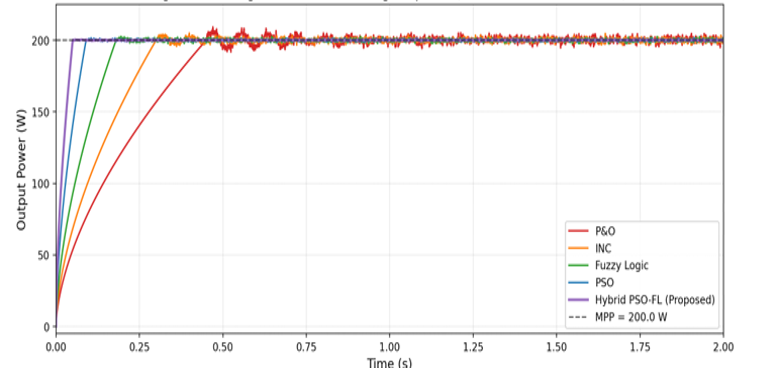
Maximum power point tracking (MPPT) is an essential control technique of PV system which optimizes energy extraction from the PV panel according to the fluctuating environmental conditions. These traditionally used methods including Perturb and Observe (P&O) and Incremental Conductance (INC) has two major disadvantages; one is power oscillations and the other are not efficient under partial shading 1. In this paper, we present a new MPPT hybrid PSO-FL (Particle Swarm Optimization-Fuzzy Logic) algorithm that integrates the global search capability of PSO with an adaptive linguistic control that is based on fuzzy logic. To validate the proposed method, it is tested with a KC200GT PV module model presented with different irradiance levels (200-1000 W/m2) and five cases of partial shading. Simulation results show that the Hybrid PSO-FL can be as efficient as 99.43% tracking efficiency, 0.05 s overall convergence time, 0.97% THD and only a 0.57% power loss in steady state under uniform … By conducting a comparative analysis with P&O, INC, Fuzzy Logic, Grey Wolf Optimizer (GWO), PSO and Artificial Neural Network (ANN), we prove the superiority of the proposed approach. These observations are further supported by statistical validation through one-way ANOVA (F = 142.7) and Wilcoxon signed-rank tests (p < 0.001).
Downloads
References
[1] International Energy Agency (IEA). Renewables 2023: Analysis and Forecasts to 2028. IEA, Paris, 2023. Available: https://www.iea.org/reports/renewables-2023.
[2] Alombah, N.H., Harrison, A., Mbasso, W.F., et al. Multiple-to-single maximum power point tracking for empowering conventional MPPT algorithms under partial shading conditions. Scientific Reports, 15(1), 14540, 2025.
[3] Endiz, M.S. Comparative analysis of P&O and IC MPPT techniques under different atmospheric conditions. El-Cezeri, 10(1), 27-35, 2023.
[4] Dagal, I., Ibrahim, A.W., Harrison, A. GWO and WOA variable step MPPT algorithms-based PV system output power optimization. Scientific Reports, 2025.
[5] Kumar, S.S., Balakrishna, K. A novel design and analysis of hybrid fuzzy logic MPPT controller for solar PV system under partial shading conditions. Scientific Reports, 14, 2024.
[6] Harrison, A., et al. MPPT algorithms for grid-connected solar systems including deep learning approaches. Scientific Reports, 2026.
[7] Kennedy, J., Eberhart, R. Particle swarm optimization. Proc. ICNN 1995 -- International Conference on Neural Networks, IEEE, vol. 4, pp. 1942-1948, 1995.
[8] Ullah, K., Ishaq, M., Tchier, F., Ahmad, H., Ahmad, Z. Fuzzy-based MPPT control system for photovoltaic power generation. Results in Engineering, 20, 2023.
[9] IEEE Standard 1547-2018: Standard for Interconnection and Interoperability of Distributed Energy Resources. IEEE, New York, 2018.
[10] Manna, S., Akella, A.K., Singh, D.K. Novel Lyapunov-based rapid and ripple-free MPPT using MRAC for solar PV system. Protection and Control of Modern Power Systems, 8(1), 2023.
[11] Belghiti, H., Kandoussi, K., Harrison, A., et al. A novel adaptive FOCV algorithm with robust IMRAC control for MPPT in standalone PV systems: experimental validation. Scientific Reports, 14(1), 31962, 2024.
[12] Zhang, X., et al. A hybrid global MPPT control method based on PSO and P&O. Electric Power Systems Research, 248, 2025.
[13] Siddique, M.A.B., Zhao, D., Jamil, H. Forecasting optimal power point of PV system using reference current based MPC under varying climate conditions. Int. J. Control Autom. Syst., 22(10), 3117-3132, 2024.
[14] Ali, M., et al. Maximum power point tracking for grid-connected PV system using adaptive fuzzy logic controller. Computers and Electrical Engineering, 110, 108879, 2023.
[15] Barakat, S., Mesbahi, A., et al. High-efficiency MPPT using ZVS quasi-resonant converter and PSO algorithm: simulation and PIL validation. Scientific Reports, 2025.
[16] Chtita, S., Derouich, A., Motahhir, S., Ghzizal, E.L.A. A new MPPT design using arithmetic optimization algorithm for PV energy storage systems under partial shading. Energy Conversion and Management, 289, 2023.
[17] Ibrahim, A.W., Xu, J., Al-Shammaa, A.A., Farh, H., Dagal, I.H.M. Intelligent adaptive PSO and linear active disturbance rejection control: A novel reinitialization strategy for partially shaded PV-powered battery charging. Computers and Electrical Engineering, 123, 2025.
[18] Kayisli, K. Super twisting sliding mode-type 2 fuzzy MPPT control of solar PV system with parameter optimization under variable irradiance. Ain Shams Engineering Journal, 14, 2023.
[19] Aifan, G., et al. A comparison of several MPPT algorithms for a photovoltaic power system. Frontiers in Energy Research, 12, 1413252, 2024.
[20] Siddique, M.A.B., Zhao, D., Rehman, A.U. Emerging maximum power point control algorithms for PV systems: review, challenges and future trends. Electrical Engineering, 2025.
Downloads
Published
Issue
Section
License
Copyright (c) 2026 Ioannis Adamopoulos, Niki Syrou, Jovanna Adamopoulou, Antonios Valamontes, Konstantina Diamanti, Panagiotis Tsirkas, Harshit Mishra (Author)

This work is licensed under a Creative Commons Attribution 4.0 International License.